Continuously Sorting Particles According to Shape
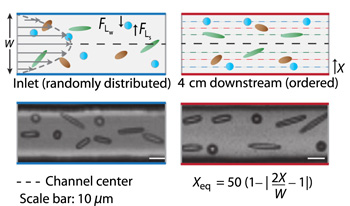
There are numerous filters to separate particles in liquid based on their size, which can be enough to isolate them; however, particle shape can be more important, as it…
Mar 4, 2013
mi·cro·flu·id·ics "mī-krə-'flü-'i-diks, noun
technology dealing with the behavior, precise control and manipulation of fluids that are geometrically constrained to a small, typically sub-millimeter, scale
Related forms
mi·cro·flu·id·ic, adjective
fu·ture 'fyü-chər, noun
something that will exist or happen in time to come